

GUIDES & INSIGHTS
What Should You Monitor in a Liquid-Cooling Loop?
Once liquid becomes part of the cooling infrastructure around AI and high-performance computing equipment, the condition of that liquid can become an important part of system operation.
But coolant monitoring is not simply a matter of installing as many sensors as possible.
Different loops use different fluids, materials, temperatures, pressures and operating strategies. A measurement that is valuable in one application may provide limited value in another.
The better question is:
What information do we actually need to understand whether this cooling loop is operating within acceptable conditions?
That question usually leads to a combination of thermal, hydraulic and fluid-condition measurements.
This guide explains several parameters commonly considered in liquid-cooling applications, what each measurement can help indicate, and why the right monitoring architecture should begin with the application rather than with a predetermined sensor package.
1. Start With the Purpose of Monitoring
Before selecting sensors, define what the monitoring system is expected to accomplish.
In one application, the priority may be confirming that coolant is reaching equipment at the correct temperature.
In another, the concern may be changes in coolant chemistry.
Elsewhere, operators may want early indication of suspended contamination, changes in glycol concentration or abnormal hydraulic conditions.
Monitoring requirements may therefore support different objectives, such as understanding operating conditions, detecting changes in fluid condition, supporting maintenance decisions or providing evidence that specified system boundaries are being maintained.
The most useful monitoring architecture is the one that answers a defined operational question.
It is not necessarily the architecture with the greatest number of measurements.
2. Think About Measurements in Three Groups
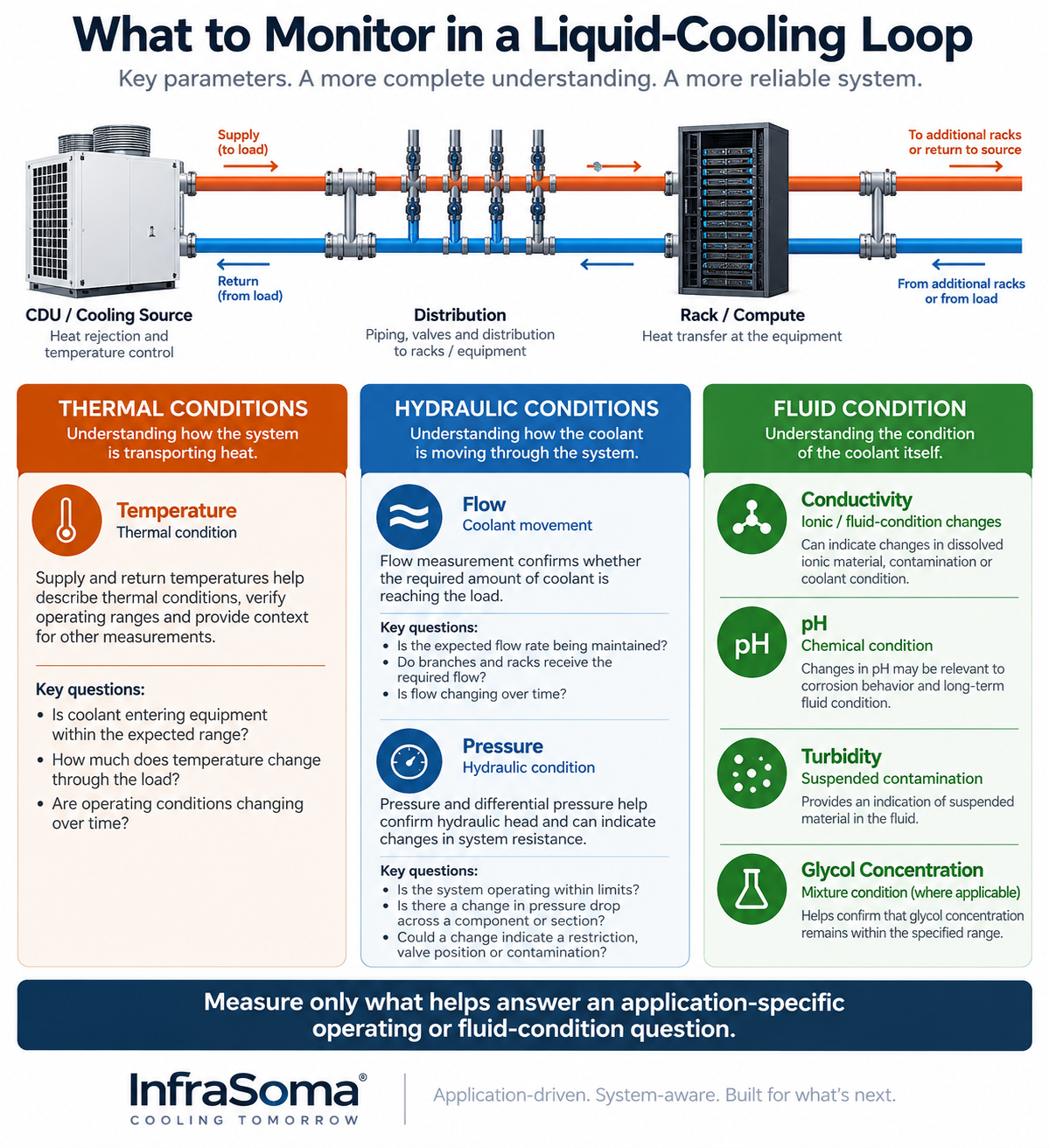
A practical way to organize coolant monitoring is to separate measurements into three categories.
Thermal conditions describe how the cooling system is transporting heat.
Hydraulic conditions describe how the coolant is moving through the system.
Fluid-condition measurements provide information about changes in the coolant itself.
Together, these three perspectives can help create a more complete picture of the loop.
For example, a temperature change may indicate a thermal condition, while an unexpected pressure or flow change may point toward a hydraulic issue. Conductivity, pH or turbidity may reveal a different kind of change occurring in the fluid.
No single parameter explains everything.
That is why coolant monitoring should be treated as a system of complementary measurements rather than as one universal sensor.
3. Temperature: The Basic Operating Context
Temperature is one of the most fundamental measurements in a liquid-cooling system.
Supply and return temperatures help describe the thermal conditions at different points in the loop.
Depending on the architecture, temperature measurements can help answer questions such as:
- Is the coolant entering equipment within the expected range?
- How much does coolant temperature change as it moves through the load?
- Are operating conditions changing over time?
- Is the cooling source delivering the expected thermal condition?
Temperature also provides context for other measurements.
Fluid properties can vary with temperature, and some sensing technologies require temperature compensation to interpret measurements correctly.
For that reason, temperature often serves as an important reference point even when the primary monitoring objective involves another parameter.
4. Flow: Is the Required Coolant Actually Moving?
A cooling system may have the correct supply temperature but still perform poorly if the required amount of coolant is not reaching the load.
Flow measurement can help confirm whether coolant is moving through the system at the expected rate.
Flow information may be useful at different levels of the architecture, including:
- system or CDU level
- distribution branches
- rack-level circuits
- individual equipment circuits where appropriate
The correct measurement location depends on what the application needs to verify.
A system-wide flow value may be sufficient for one installation.
Another may require branch-level visibility because multiple racks or equipment circuits share the same distribution system.
The purpose should determine the measurement location.
5. Pressure: Understanding the Hydraulic Condition
Pressure helps describe the hydraulic state of the cooling circuit.
Depending on where it is measured, pressure information can help identify whether the system is operating within equipment limits and whether sufficient hydraulic head exists to move coolant through the intended path.
Differential pressure can also provide useful information.
For example, increasing pressure drop across a component or section of the loop may indicate that hydraulic resistance is changing.
That does not automatically identify the cause.
A pressure change could relate to several factors, including flow conditions, valve position, restrictions or contamination.
Pressure therefore becomes more useful when interpreted together with other system information.
6. Conductivity: Watching for Changes in the Fluid Environment
Electrical conductivity describes how readily a fluid conducts electrical current.
In coolant systems, conductivity can provide information about the ionic condition of the fluid.
Changes in conductivity may be associated with changes in dissolved ionic material, contamination, coolant condition or interaction with materials in the loop.
The important point is that conductivity is generally more useful as a trend and context measurement than as a standalone diagnosis.
A conductivity value by itself does not tell you exactly what caused a change.
It needs to be interpreted against:
- the coolant specification
- baseline conditions
- temperature
- materials in the loop
- treatment or inhibitor package
- acceptable limits defined for the application
This is why monitoring begins with defined requirements.
Without an expected operating range or baseline, a sensor can produce data without necessarily producing useful information.
7. pH: Understanding Chemical Condition
pH describes how acidic or alkaline an aqueous fluid is.
In liquid-cooling systems, changes in pH may be relevant because coolant chemistry and materials compatibility can affect corrosion behavior and long-term fluid condition.
As with conductivity, pH should not be interpreted in isolation.
A change in pH can be meaningful, but understanding that change requires context around the coolant formulation, materials, inhibitors, operating temperature and system history.
The appropriate pH range should therefore come from the coolant and system requirements rather than from a universal number applied to every liquid-cooling loop.
Monitoring becomes useful when measured values can be compared against an application-specific expectation.
8. Turbidity: Looking for Suspended Contamination
Turbidity provides an indication of how much suspended material is affecting the clarity of a fluid.
In a cooling loop, an increase in turbidity may provide evidence that the amount of suspended contamination has changed.
Potential contributors could include particulate contamination, corrosion products or other material entering or forming within the circuit.
Turbidity does not identify exactly what those particles are.
It is therefore better viewed as an indicator that the physical condition of the fluid may have changed.
If the application requires more detailed contamination analysis, additional methods may be necessary.
But as part of a monitoring architecture, turbidity can provide another data point alongside chemistry, filtration and hydraulic information.
9. Glycol Concentration: When the Coolant Is a Mixture
Some cooling applications use water-glycol mixtures rather than water alone.
Where glycol is present, concentration can affect physical properties and system behavior.
For that reason, an application may need to know whether the glycol concentration remains within its specified range.
The relevant concentration depends on the coolant formulation and the reason glycol is being used.
A monitoring approach may therefore consider questions such as:
- Is the fluid mixture within the specified concentration range?
- Has dilution or concentration changed?
- Does the measurement need to compensate for temperature?
- Is the system using propylene glycol, ethylene glycol or another fluid formulation?
As with the other parameters discussed here, concentration measurement should support a defined application requirement rather than be added simply because the measurement is available.
10. No Single Measurement Defines “Coolant Health”
It can be tempting to look for one parameter that represents the overall condition of the coolant.
In practice, fluid condition is more complicated.
Conductivity can change while turbidity remains stable.
Turbidity can increase without explaining the chemical nature of the contamination.
pH can move while hydraulic performance appears normal.
Flow and pressure may change even though the coolant chemistry has not.
Temperature affects both system operation and the interpretation of other measurements.
This means that the most useful monitoring architecture is usually based on relationships among measurements, not a single “coolant health” number.
The application determines which relationships matter.
11. Trend Information Can Be More Useful Than a Single Reading
A single measurement provides a snapshot.
A series of measurements can show how the system is changing.
For many monitoring applications, the question is not simply whether a value is high or low at one moment.
The more useful questions may be:
- Is this parameter drifting?
- Did it change after maintenance?
- Is the change gradual or sudden?
- Does it correlate with temperature, flow or another operating condition?
- Has the system moved away from its established baseline?
Trend information can therefore help distinguish normal variation from a condition that deserves investigation.
This does not mean every application requires continuous remote monitoring.
The appropriate data-collection method depends on the importance of the parameter, how quickly conditions may change and what action will be taken when a change is observed.
12. Measurement Location Matters
Selecting the sensor is only part of the problem.
Where the measurement is taken can significantly affect what the data represents.
A measurement near a CDU may describe the overall coolant condition entering the distribution system.
A rack-level measurement may reveal conditions closer to the equipment.
A branch measurement may help compare different parts of a distribution architecture.
A sample or bypass loop may provide a different measurement environment than an inline sensor.
The correct location depends on the question being asked.
Before defining a monitoring point, consider:
- What part of the system should this measurement represent?
- Is the coolant well mixed at this location?
- Is the sensor exposed to representative flow?
- Does the measurement require a particular flow condition?
- Can the device be maintained or calibrated?
- Will the installation itself create unacceptable pressure drop or service complexity?
Sensor location should therefore be considered as part of the cooling-system architecture rather than as an afterthought.
13. Baselines and Limits Need to Come From the Application
Data becomes more useful when there is something meaningful to compare it against.
That can include:
- coolant-manufacturer specifications
- OEM operating requirements
- facility requirements
- equipment limits
- an established commissioning or operating baseline
- project-specific engineering limits
Not every parameter needs the same type of threshold.
Some may have defined allowable ranges.
Others may be monitored primarily for relative changes or trends.
The important step is to determine in advance what the measurement means and what action should follow if the value changes.
A monitoring system without defined interpretation can create large amounts of data without improving engineering decisions.
14. Monitoring and Protection Are Related, But They Are Not the Same
Monitoring provides information.
Protection determines what happens when an unacceptable condition is detected.
For example, a sensor may indicate that a parameter has changed.
The broader system then needs to determine whether that condition should:
- generate an alert
- trigger further inspection
- change an operating condition
- initiate maintenance
- isolate part of the system
- or simply be recorded for trending
Similarly, leak detection identifies the presence of liquid where it should not be, while a protection architecture determines what response should follow.
This distinction is useful when defining system requirements.
A measurement requirement should identify both what must be known and, where appropriate, what the system should do with that information.
15. Avoid Measuring Everything
Adding more sensors can create more data, more installation points, more maintenance and more integration work.
That does not automatically create more useful information.
A better approach is to start with a short set of questions.
- What condition are we trying to understand?
- What failure or degradation mode are we concerned about?
- Which measurement would provide meaningful evidence?
- Where should that measurement be taken?
- How accurate does it need to be?
- How often does it need to be observed?
- What decision will be made from the result?
If there is no clear answer to the last question, the measurement may not be necessary.
This is the same customer-pull principle that applies to the broader cooling architecture: define the need first, then select the technology.
16. Build the Monitoring Architecture Around the Application
For one application, temperature and flow may provide most of the information needed.
Another may require conductivity and pH because fluid chemistry is more important.
Another may benefit from turbidity because contamination risk is a central concern.
A glycol-based system may need concentration information.
More complex applications may combine several of these measurements.
The goal is not to create one universal sensor package.
The goal is to create a measurement architecture that matches the coolant, materials, equipment and operating requirements of the specific system.
InfraSoma describes this application-driven approach as Fluid Intelligence.
17. Define Monitoring Requirements in the RFQ
Monitoring requirements should be defined alongside the rest of the cooling-system requirements.
A useful RFQ should make clear what the customer needs to understand about the system.
That may include the parameters to be measured, measurement locations, expected operating range, required accuracy, environmental conditions, communication interface, installation constraints and documentation expectations.
The RFQ does not necessarily need to specify a particular sensor model.
In many cases, defining the required measurement outcome gives suppliers and integrators more flexibility to propose an appropriate approach.
How to Define Requirements for a Liquid-Cooling Application →
Start With the Question You Need the Data to Answer
Coolant monitoring should not begin with a list of sensors.
It should begin with the engineering question.
What needs to be known?
Why does it matter?
Where should it be measured?
What constitutes an acceptable condition?
What action follows when the condition changes?
Once those questions are clear, the monitoring architecture becomes easier to define.
InfraSoma can help organize application requirements and identify an appropriate sensing, protection or configuration path around the needs of the cooling system.