

GUIDES & INSIGHTS
How to Define Requirements for a Liquid-Cooling Application
Selecting components too early can lock a liquid-cooling project into assumptions that do not match the actual operating environment. Coolant conditions, thermal requirements, flow and pressure constraints, mechanical interfaces, sensing, protection, documentation and qualification expectations can all influence one another.
A better starting point is to define the application requirement first — then determine which technologies, interfaces and configurations are appropriate.
Selecting components too early can lock a liquid-cooling project into assumptions that do not match the actual operating environment.
Coolant conditions, thermal requirements, flow and pressure constraints, mechanical interfaces, sensing, protection, documentation and qualification expectations can all influence one another. A component that appears suitable in isolation may create limitations elsewhere in the system.
A better starting point is to define the application requirement first then determine which technologies, interfaces and configurations are appropriate.
This guide outlines the information that should be established before selecting liquid-cooling technologies or preparing an RFQ.
1. Start With the Application
Before specifying sensors, manifolds, filtration, hoses or other hardware, define what the cooling system actually needs to support.
Begin with the operating context:
- What equipment or subsystem is being cooled?
- Is this a new platform, retrofit or modification of an existing architecture?
- Is the requirement at the rack, CDU, distribution or equipment level?
- What stage is the project in: concept, prototype, qualification or production?
- What physical and environmental constraints already exist?
- Which interfaces are fixed, and which can still be changed?
These questions establish the technical boundary for everything that follows.
For an OEM developing a new cooling platform, interface flexibility may still be relatively high. In an existing data-center environment, the rack, coolant distribution, operating procedures and maintenance constraints may already be established.
The same component therefore may not be appropriate in both situations.
The objective is not to begin with a catalog. It is to begin with the requirement.
Related: Applications
2. Define the Thermal and Hydraulic Conditions
Liquid-cooling architecture depends heavily on the thermal and hydraulic operating envelope.
At minimum, define the expected:
- heat load or thermal duty
- coolant inlet and outlet temperatures
- acceptable temperature range
- required or expected flow range
- operating pressure
- allowable pressure drop
- transient or variable-load conditions
- system operating limits
These parameters influence component sizing, distribution architecture, instrumentation and control decisions.
The goal at this stage is not necessarily to complete every detailed calculation. It is to establish enough of the operating envelope that technologies can be evaluated against realistic conditions.
For example, a monitoring device selected without understanding the expected flow, temperature or pressure environment may later require changes in installation method, range or configuration.
Similarly, a manifold or hose assembly should not be selected without considering the flow paths and pressure-drop constraints of the surrounding system.
3. Define the Coolant and Fluid Environment
The cooling fluid itself is part of the engineering requirement.
Important questions include:
- What coolant chemistry will be used?
- Is the fluid water-based, glycol-based or another approved formulation?
- If glycol is used, what concentration range is expected?
- What is the normal operating-temperature range?
- What materials will the fluid contact?
- What cleanliness level is expected?
- Are contamination, corrosion or degradation concerns significant?
- Will fluid condition need to be monitored over time?
These decisions affect sensing, filtration, seals, wetted materials, maintenance strategy and potentially calibration requirements.
They also affect what should be measured.
A system that only needs basic operating visibility may require a different sensing architecture than one where coolant concentration, conductivity, turbidity or other fluid-health indicators are important.
The key is to avoid selecting measurements simply because they are technically available.
Measure what the application needs to know.
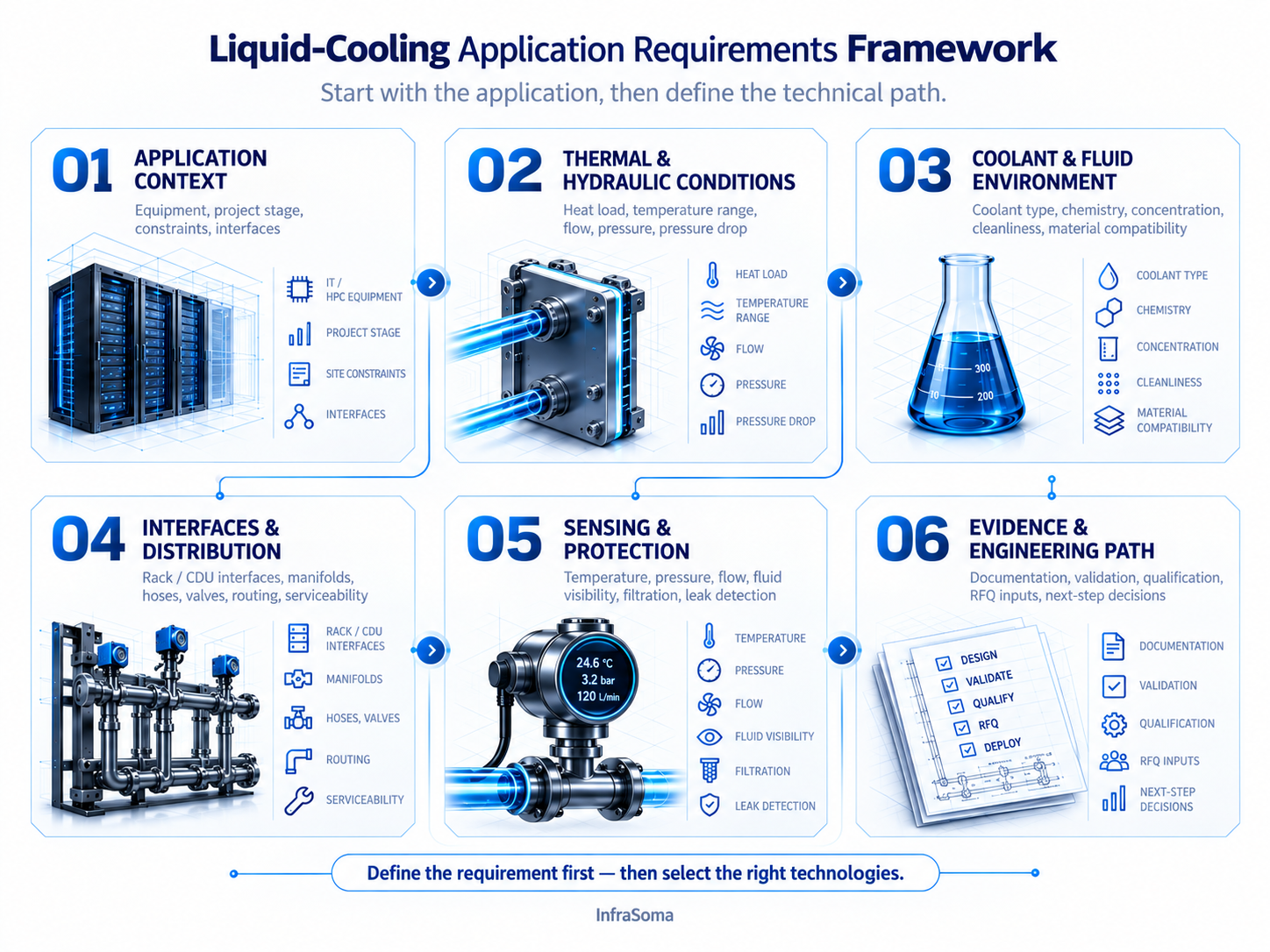
Define the requirement first — then select the right technologies.
4. Map the Physical Interfaces and Distribution Architecture
Liquid-cooling systems rarely consist of isolated components. The project should define how coolant moves through surrounding infrastructure and where each technology must connect.
Typical considerations include:
- CDU interfaces
- rack interfaces
- manifolds
- distribution blocks
- hoses
- connection types
- valves
- flow-routing requirements
- available installation space
- service access
- orientation and packaging constraints
Physical compatibility is only one part of the problem. A connection may technically fit while still creating poor routing, difficult service access or an unfavorable pressure-drop condition.
Likewise, a manifold architecture may be mechanically feasible but inappropriate for required flow distribution or future serviceability.
This is why distribution and interface decisions should be evaluated as part of the overall application rather than as independent purchasing decisions.
Related: Rack Cooling Distribution
5. Define What Needs to Be Measured
Instrumentation should begin with the question: What information is needed to operate, protect or evaluate the cooling system?
Possible measurements may include:
- temperature
- pressure
- flow
- coolant concentration
- conductivity
- pH
- turbidity
- other fluid-condition indicators
Not every application requires every measurement. Temperature may be fundamental operating context, while concentration, conductivity, pH or turbidity may matter where fluid condition or contamination requires visibility.
text, while concentration, conductivity, pH or turbidity may matter where fluid condition or contamination requires visibility.Before choosing a sensor, define what decision the measurement supports, required range and accuracy, measurement location, frequency, data use, and acceptable calibration or maintenance burden.
Related: Fluid Intelligence
6. Define Protection Requirements
Protection requirements should also be established early. Consider:
- filtration needs
- expected contamination sources
- particle-control requirements
- leak-detection needs
- consequences of leakage
- required response to a detected condition
- serviceability and replacement access
A filtration requirement should not be defined only by selecting a filter size or product. Ask what contamination the system controls, where it enters or develops, what equipment is protected, and what maintenance strategy is realistic.
Leak protection depends on where leakage could occur, how quickly it must be detected and what action should follow.
Related: Fluid Protection
7. Define Documentation and Evidence Requirements
Technical requirements are only part of the project. Customers, OEMs and integrators may also require evidence before a configuration can advance.
Examples include:
- technical datasheets
- material information
- interface drawings
- test methods
- supplier documentation
- calibration information
- validation requirements
- qualification criteria
- traceability expectations
Identify expectations early. A disciplined project should establish what must be demonstrated, who generates evidence, what documentation is accepted, when evidence is needed, and what decision it enables.
InfraSoma's engineering model can help frame requirements and the associated evidence pathway around the application.
Related: Engineering & Services
8. Separate Current Requirements From Future Capability
A common source of unnecessary complexity is designing future possibilities into the first configuration before there is a real customer or technical requirement.
Examples might include advanced telemetry, additional sensing, custom electronics, software integration, deeper subsystem integration, field-service infrastructure and additional monitoring capability.
These capabilities may become valuable later, but should be driven by actual application requirements, customer pull and technical evidence.
A useful requirement review separates:
- What is required now?
- What may be required as the project matures?
- What is technically possible but not currently justified?
That distinction can reduce cost, shorten development cycles and keep engineering effort focused on the real problem.
9. Turn the Requirements Into a Useful RFQ
A good RFQ should provide enough technical context for a supplier or engineering partner to understand the application rather than simply quote a part number.
Before requesting a quote, try to define the following.
Application
- Equipment or environment being supported
- New design, retrofit or replacement
- Project stage
- Expected production or deployment timing
Thermal
- Expected thermal load
- Inlet and outlet temperature requirements
- Operating range
Hydraulic
- Flow range
- Pressure range
- Pressure-drop constraints
Fluid
- Coolant type
- Expected concentration where applicable
- Temperature range
- Cleanliness or contamination concerns
- Material-compatibility requirements
Interfaces
- Rack or CDU interfaces
- Hose and connection requirements
- Manifold requirements
- Available space
- Routing constraints
Sensing
- Parameters that must be measured
- Required measurement range
- Accuracy expectations
- Communications or signal requirements
- Calibration expectations
Protection
- Filtration requirements
- Contamination concerns
- Leak-detection needs
- Required response to abnormal conditions
Evidence
- Required documentation
- Test or validation expectations
- Qualification criteria
- Traceability requirements
Commercial
- Prototype or sample quantity
- Expected production volume
- Target timing
- Packaging or private-label requirements where relevant
Not every project will have answers to every question at the beginning.
The purpose of this framework is to identify what is known, what remains open and which uncertainties matter before a technology decision is made.
Start With the Application
Liquid-cooling infrastructure is a connected system.
Thermal conditions influence flow requirements. Fluid chemistry influences sensing and materials. Distribution architecture affects pressure drop and interfaces. Protection requirements influence filtration and leak detection. Documentation and evidence requirements can affect technology selection long before production.
Defining those relationships early makes it easier to select the right technologies — and easier to identify where additional engineering or evidence is actually needed.
InfraSoma starts with the application requirement and works outward from there.
If you're defining a new liquid-cooling platform, evaluating an existing architecture or preparing an RFQ, the first step is to establish the operating conditions, interfaces and technical requirements that will govern the solution.